
Products
AI music generators do not need to replace the DAW
The valuable frontier is not a browser copy of Ableton or Logic. It is better control over what enters a model, what can be regenerated, and what leaves as editable material.
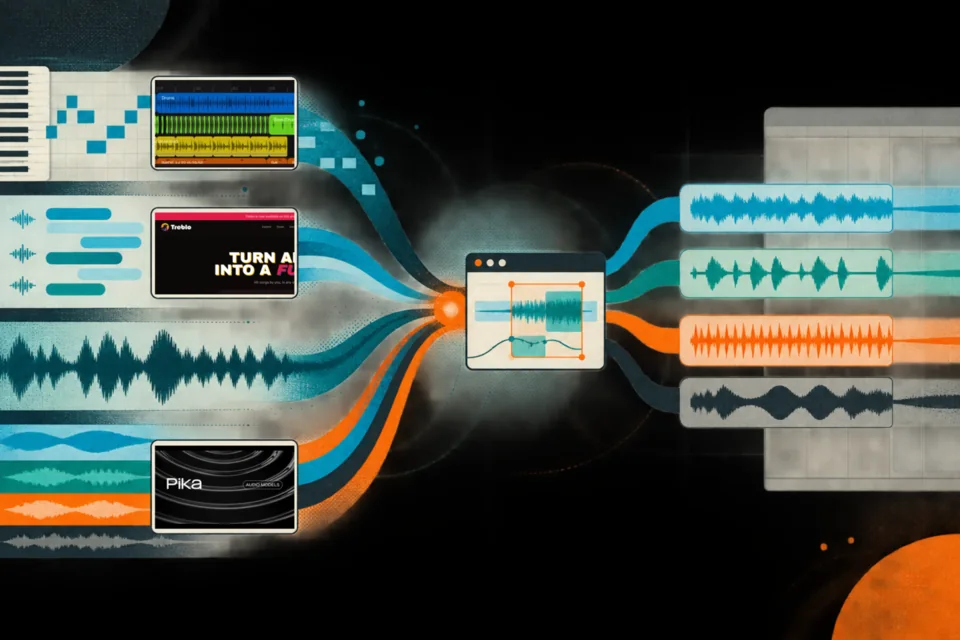
Suno Studio 2.0 makes the current ambition unusually visible: the music generator wants a timeline, MIDI, synths, automation, effects and a conversational plugin builder. Video generators are making the same move toward browser editing suites. The direction is understandable, but it risks confusing a useful control surface with the place where every project must finish.
A producer already has a destination. It may be Ableton Live, Logic Pro, Pro Tools, FL Studio or another environment with years of learned shortcuts, routing, plugins and collaborators. Rebuilding all of that inside each generator creates several smaller, incompatible studios. Most serious work will still leave the generator.
Inputs are the scarce surface
What creators cannot get from a conventional DAW is precise access to the model. Pika Music accepts combinations of a prompt, lyrics, a musical reference and a voice reference. HappyShrimp exposes lyrics, musical instructions and reference audio. Suno can now treat MIDI as a prompt. These are not cosmetic additions: each one converts an existing piece of human intent into a constraint the model can follow.
That suggests a better product test. Can the system accept the form in which an idea already exists — chords, melody, rhythm, voice, arrangement, reference audio or a rough performance — without flattening it into prose? Can a user lock the parts that work and change only the part that does not?
The timeline should govern generation
A timeline is valuable when it answers generative questions: where should a section extend, which vocal line should be replaced, which stem should be regenerated, and what context should the model preserve? Treblo's inpainting, extension and stem tools point in this direction. So do region-based generation and MIDI-conditioned audio in Suno Studio.
The same timeline is less differentiated when it merely duplicates trimming, fades and stock effects. Those functions are useful, especially for a first-time creator, but they are not the durable advantage of an AI-music system.
A strong exit is part of the product
The ideal generator has a wide entrance and a predictable exit: separate stems or layers, stable timing, useful metadata and standard high-quality files. The user can then choose whether to finish inside the service or move to a mature production environment.
AI-first tools may eventually become full production homes for some musicians. They do not need to win that argument today. The nearer and more defensible job is to make generation controllable, local, reversible and portable.