
Research
Five July papers move AI music beyond the one-shot song prompt
New work explored playable soundscapes, compensation signals, low-data training, structured composition and full-song rendering.
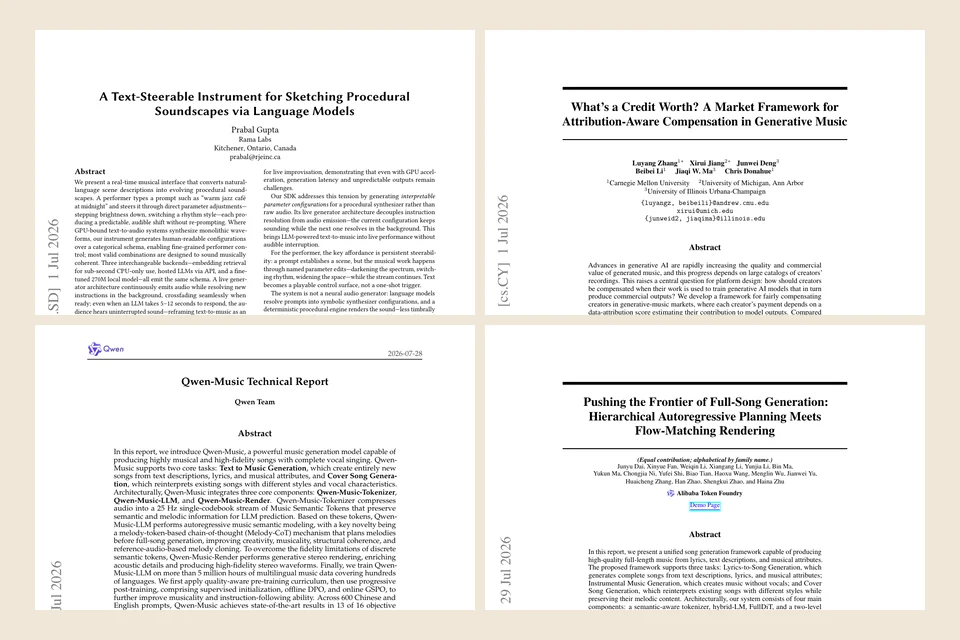
July's most useful AI-music papers were not all trying to win the same text-to-song benchmark. They addressed different parts of the stack: instruments, datasets, attribution, planning and long-form rendering.
Text as a live soundscape control
A NIME 2026 paper describes a real-time procedural soundscape instrument that translates text into a human-readable configuration, then continuously renders and crossfades audio. The authors compare general LLM, fine-tuned and CPU-oriented backends. Their CLAP-based evaluation is a proxy for semantic fit, not a listening study, but the interface points toward playable systems rather than one-off exports.
Attribution as a market signal
Another paper models how catalog-level attribution could influence compensation. Its central result is conditional: fixed fees or royalties become more useful depending on how informative the attribution signal is. This is an economic framework, not a deployed payment system, but it makes the measurement problem explicit.
Learning with less data
An ICME 2026 challenge submission tests clustered training batches for low-data text-to-music systems. Grouping examples by text embeddings improved the reported objective metrics relative to audio clustering, while cluster size created tradeoffs. The result is narrow, but useful for teams that cannot train on millions of hours.
Planning before rendering
The Qwen-Music report describes a tokenizer, language model, renderer and “Melody-CoT” planning approach. Its authors report training on more than five million hours of multilingual music and strong benchmark results. Those are company-paper claims and need independent reproduction.
A separate full-song paper proposes hierarchical autoregressive planning followed by a FullDiT flow-matching renderer with whole-song context. It targets lyrics, instrumentals and cover tasks while trying to preserve structure across long outputs. Again, the reported quality comes from the authors' own evaluation.
Together, the papers suggest a shift from “generate a plausible clip” toward systems that can be controlled, credited, trained efficiently and asked to hold a musical plan over an entire song.