
Rights & policy
South Korea's KOMCA withdraws its new AI-assisted registration rule
The collecting society reversed its August policy after government and parliamentary objections. AI-assisted works are blocked again while a broader standard is discussed.
AI-assisted
AI assisted with research organisation and drafting; the editor checked the published wording and claims against the linked sources.
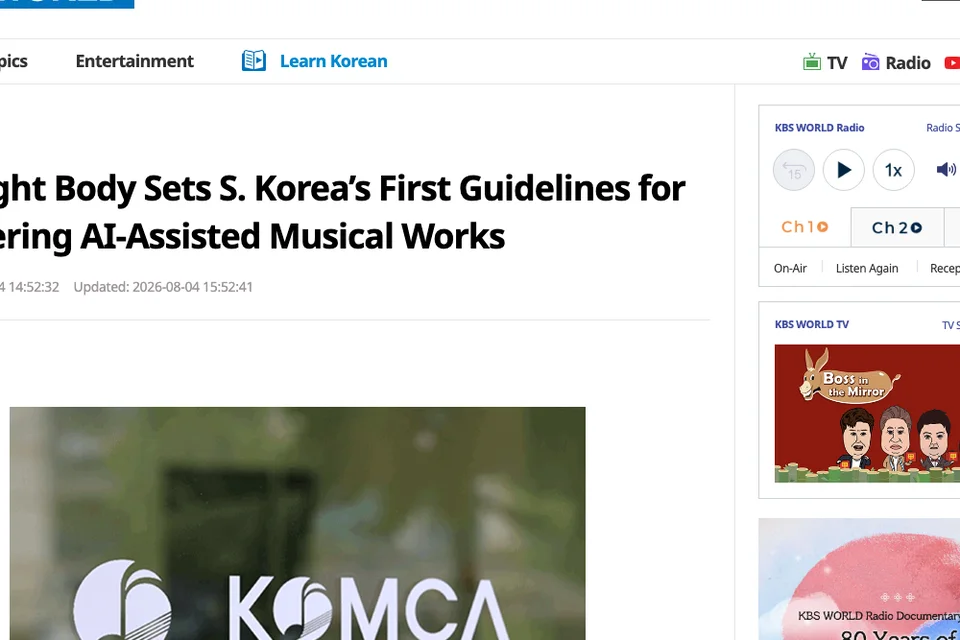
The Korea Music Copyright Association has withdrawn the AI-assisted music registration rule it introduced at the beginning of August. KOMCA's board voted on 25 August to rescind the amendments governing work registration and the related trust-contract terms.
The short-lived rule had allowed registration when a human made a substantial, leading contribution to writing, composition or arrangement. Applicants were expected to disclose the tools used, identify AI-generated portions and describe their own contribution; prompt-only output remained ineligible.
AI-assisted works are now blocked from KOMCA registration again while a replacement standard is discussed. The reversal governs the collecting society's registration practice; Korean courts have not ruled every AI-assisted work uncopyrightable.
The reversal came before a wider legal consensus
Korea JoongAng Daily reports that the Ministry of Culture, Sports and Tourism asked KOMCA on 18 August to wait for broader discussion across the cultural sector. A member of the National Assembly had also challenged the change on the ground that legislation and social consensus had not caught up with it.
KOMCA says the withdrawal does not end its work on AI-assisted music. It plans to develop legal and institutional standards with government, lawmakers and industry participants, while continuing measures against false registrations and distorted royalty distributions under existing rules.
Any replacement will still need a traceable account of who did what, backed by drafts, stems, session files or edit history. The current registration route has disappeared; the evidence problem has not.