
Research
Yandex Music reports replacing a 15-plus recommender cascade with Sona
One generative recommendation model beat the existing My Vibe stack in a smart-speaker test, according to a new technical report.
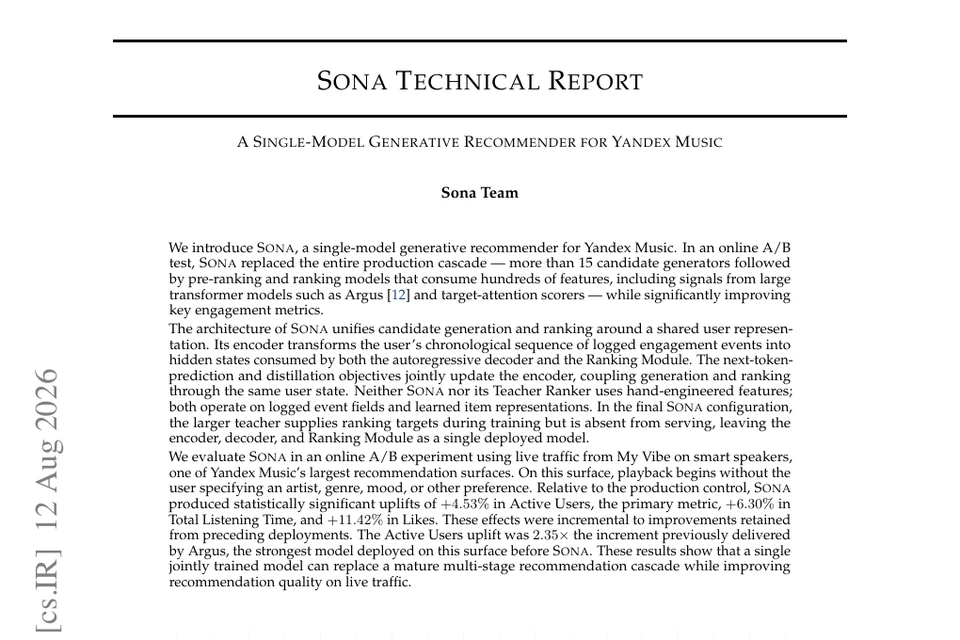
Yandex Music has published a technical report for Sona, a single-model generative recommender tested on My Vibe for smart speakers. This is not a music generator: it decides what a listener should hear next.
The production system it challenged was substantial. More than 15 candidate generators proposed tracks, then separate pre-ranking and ranking models processed hundreds of features. Sona instead uses one shared representation of a listener's chronological activity for both candidate generation and ranking. A larger teacher helps during training but is not needed when the model is serving recommendations.
The reported result
In Yandex's online A/B test, Sona replaced the full production cascade on the smart-speaker My Vibe surface. The paper reports relative gains of 4.53% in active users, 6.30% in total listening time and 11.42% in likes. It also says the active-user gain was 2.35 times the increment previously delivered by Argus, an earlier transformer recommender.
These are the authors' production-test results, not an independent audit. The paper concerns one recommendation surface and does not establish that the same architecture will produce the same gains on mobile, desktop or every catalogue and audience.
Why it matters for AI music
Most AI-music coverage focuses on generating tracks. Recommendation systems decide whether those tracks — and everything around them — are found at all. A single generative model replacing a mature multi-stage stack could simplify serving and let generation and ranking learn from the same listener history.
It also concentrates more of the discovery decision inside one model. That makes evaluation beyond engagement important: catalogue diversity, artist exposure, repetition, cold-start behaviour and the treatment of synthetic music are all unanswered by the headline uplift numbers.
Sona is significant because it shows generative modelling moving deeper into music distribution, not because it writes songs.