
Rights & policy
What the EU AI Act's new transparency rules mean for music
Article 50 now applies. Providers must machine-mark synthetic audio, while public disclosure depends on who deploys it and how it is used.
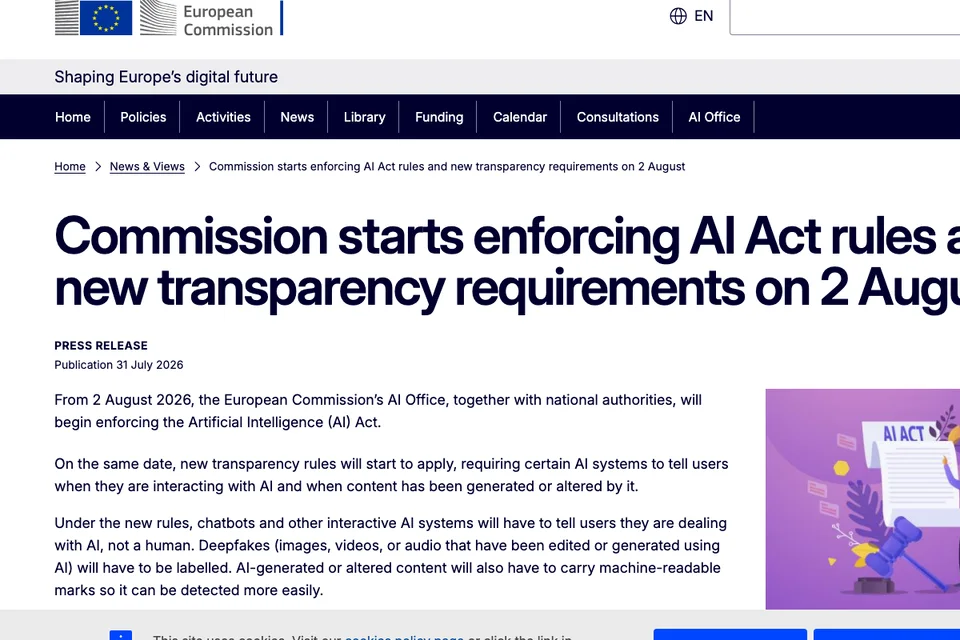
The EU AI Act's transparency obligations under Article 50 began applying on 2 August 2026. For AI music, the headline is simple — synthetic audio needs provenance — but the law separates two different responsibilities that are often compressed into “add an AI label.”
Providers of systems that generate or manipulate audio must make the output detectable in a machine-readable way. The marking should be effective, interoperable, robust and reliable as far as technically feasible. This is a product obligation aimed at the generated file or signal.
Deployers have a different duty when synthetic audio qualifies as a deepfake: they must disclose that the content was artificially generated or manipulated. The disclosure must be clear and made no later than the first exposure to the content.
Not every use of AI becomes a public deepfake label
The Commission's guidance distinguishes synthetic media that appears authentic from obviously fictional or creative work. It also describes an exception for systems that perform standard assistive editing without substantially altering the input or its meaning. A private, non-professional use can fall outside the deployer obligation.
That means a mastering assistant, a generated instrumental and a voice clone presented as a real singer should not be treated as one category. The relevant questions are what the system produced, whether the result could be mistaken for authentic content, and whether it is being published in a professional context.
Providers whose systems were placed on the market before 2 August have a limited transition for the marking and detectability requirement until 2 December 2026. That is not a general postponement of Article 50.
What creators and platforms should do now
Keep the provenance information attached to exported audio where the tool supplies it. Record which parts were generated or materially altered. Platforms and distributors should preserve machine-readable signals during transcoding and give publishers a component-level disclosure path rather than one vague “made with AI” checkbox.
The Commission lists maximum penalties of €15 million or 3% of worldwide annual turnover for breaches of obligations other than those concerning prohibited practices or provider information. Actual enforcement depends on the facts, the responsible actor and national procedures. This article is a practical reading of the published guidance, not legal advice.