
Rights & policy
The Spotify hit Sweden's official chart would not count
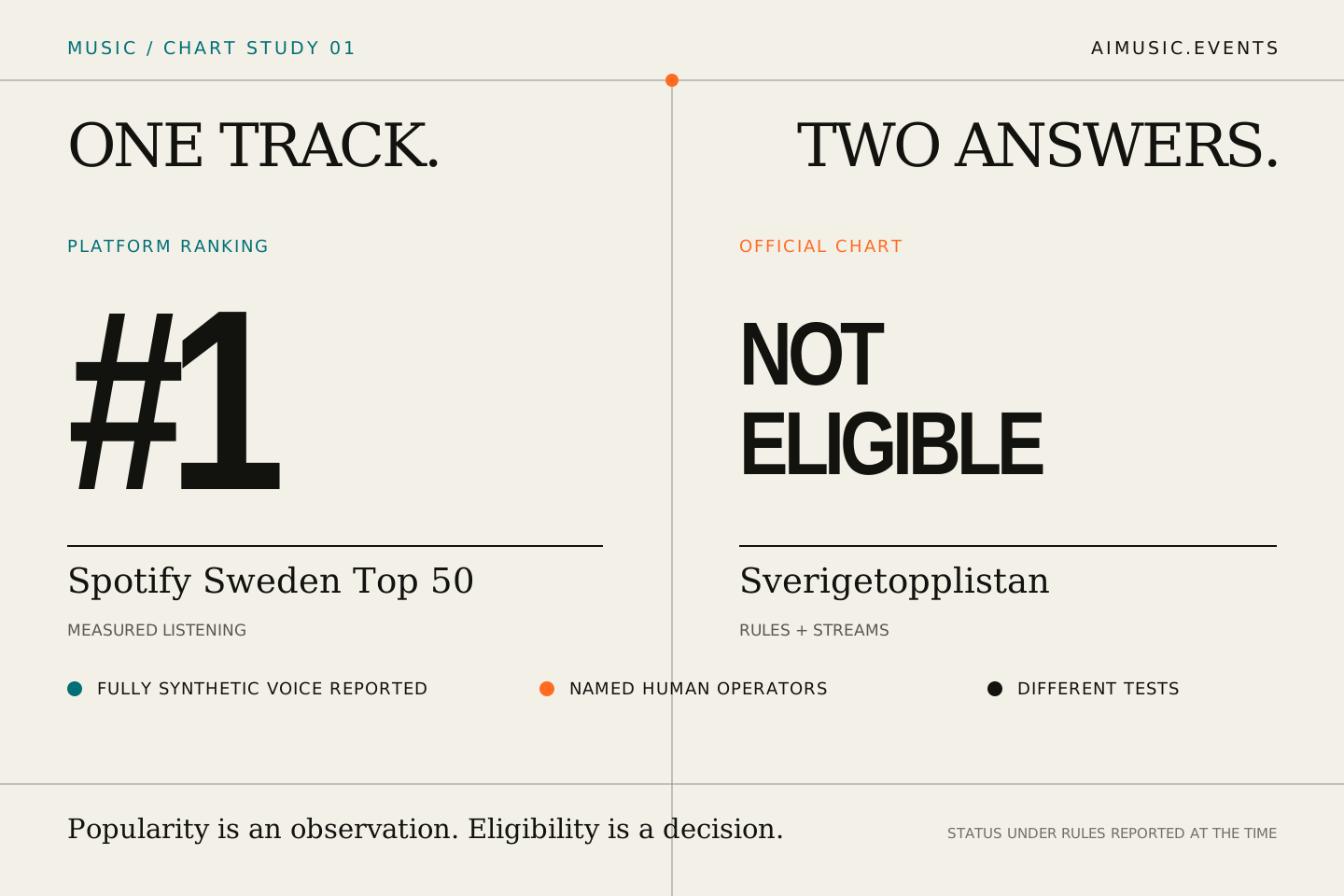
Jag vet, du är inte min reached No. 1 on Spotify Sweden, but its fully synthetic voice produced a different answer under IFPI's chart rules.
AI-assisted
AI assisted with research organisation, structure and drafting; publication requires a human editor to check every claim against the linked sources.

The same recording can be a number-one hit and absent from a national chart without either result being a mistake.
“Jag vet, du är inte min,” released under the name Jacub, reached the top of Spotify's Sweden Top 50. Sveriges Radio reported that the voice was fully AI-generated and named Lasse Persson and Mårten Winter among the people behind the project. The pair described a process using AI services alongside Logic, but the available account does not provide a complete contribution ledger or identify every system used.
The track's rise made two different forms of measurement visible. Spotify's daily list observed listening on one platform. Sverigetopplistan, produced by IFPI Sweden, applied eligibility rules before turning consumption into an official industry ranking. At the time, IFPI told the broadcaster that a recording judged to be principally AI-generated could not enter its chart.
Two lists, two questions
| System | Question | Result for the track |
|---|---|---|
| Spotify Sweden Top 50 | What is being streamed on Spotify now? | No. 1 |
| Sverigetopplistan | Which eligible releases rank across the measured market? | Not eligible under the rules reported at the time |
The distinction is more than administrative. A platform ranking is a behavioural signal. An official chart is an institution: it defines the category it claims to measure. When generative systems make it possible to release recordings without a conventional performer—or with only partial public credits—the category boundary becomes part of the story.
Sweden has now made the boundary more explicit
On 11 August 2026, IFPI Sweden announced revised rules for recordings created with generative AI, effective with the chart published on 21 August. The new framework says a qualifying recording must be principally human-created and must satisfy several additional conditions:
- the generative service must be lawful and hold the required rights and permissions;
- the release must not be linked to suspected manipulation or artificial streaming;
- the use must comply with copyright, neighbouring rights and protections for name, image, voice and personality;
- the recording must be made available under the distribution service's terms;
- AI use must be clearly disclosed on music services.
These criteria do not say that any use of AI disqualifies a recording. They ask where the principal creative contribution sits, whether the production chain is lawful and whether listeners and chart operators receive meaningful disclosure.
Nor should the August framework be presented as a retroactive ruling on every detail of the Jacub release. The earlier case exposed the gap between popularity and eligibility. The updated rules describe the evidence future releases are expected to provide.
What remains unknown is part of the record
The cited reporting confirms a synthetic voice, named human operators and the broad use of AI services with a digital audio workstation. It does not establish a complete split between lyric writing, composition, arrangement, sound design, model output and final editing. It also does not identify the training provenance or licensing status of every service involved.
Those absences are not a reason to ignore the release. They are exactly why chart rules now reach beyond a binary “AI or not” label. A defensible music record needs both kinds of information: evidence that people listened, and evidence about what they were listening to.