
Rights & policy
Russia's new AI law does not impose a blanket music label
Federal Law 243-FZ creates a route for AI-content notices from March 2027, while Yandex Music, KION Music and Zvuk are making different product and policy choices.
AI-assisted
AI assisted with research organisation and drafting; the editor checked the published wording and claims against the linked sources.
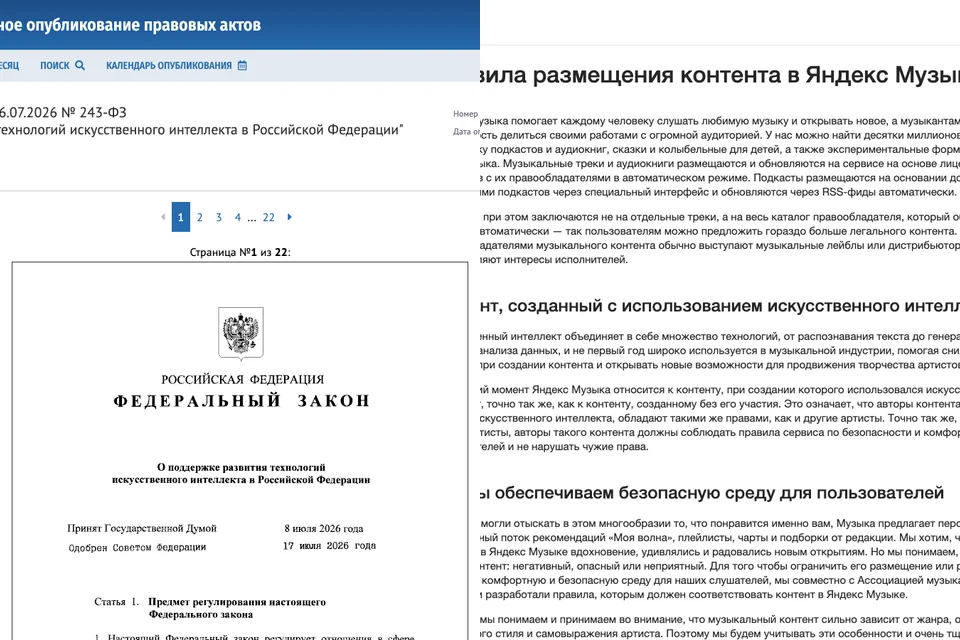
Russia has enacted Federal Law No. 243-FZ on large foundation models. It was signed on 26 July and officially published the same day. Most of the law takes effect on 1 September 2026; the provisions covering content notices, model access and use of protected works take effect on 1 March 2027.
Article 9 is narrower than a universal “AI music must be labelled” rule. It says people using a large foundation model to create audio or visual material must be given a way to place an AI-use notice. Large Russian-language platforms with more than 500,000 daily users in Russia must provide that facility for user pages. The notice format is left to agreements between the user and service. The text does not turn every use of an AI-assisted music tool into an automatic public label.
Platforms are already choosing different lines
Yandex Music's current public rules say AI-assisted music and audiobooks receive the same baseline treatment as other content, with the same rights and safety requirements. Reports that the service is separately asking rights holders for AI-component metadata have not been confirmed in its public rules, so we are not treating that request as a published platform mandate.
KION Music now presents a separate “Настоящий чарт.” The public chart page is live; Russian technology reporting describes it as a human-only ranking that excludes fully AI-generated tracks while allowing some assisted work. KION has not published the full detection, evidence or appeal method on the chart page, so disputed classifications remain an operational question.
Zvuk's creator service has also opened “Сингл,” a full-song generator with model, lyrics, genre and library controls. Its help page explains how the product works and assigns responsibility for uploaded and generated material to users. It does not clearly grant broad commercial rights on that page, so claims that use is either freely commercial or categorically prohibited need the service's exact contract, not a social post.
The practical picture is three separate layers: national law, platform moderation and product terms. They should not be collapsed into one claim about what “Russia requires.”